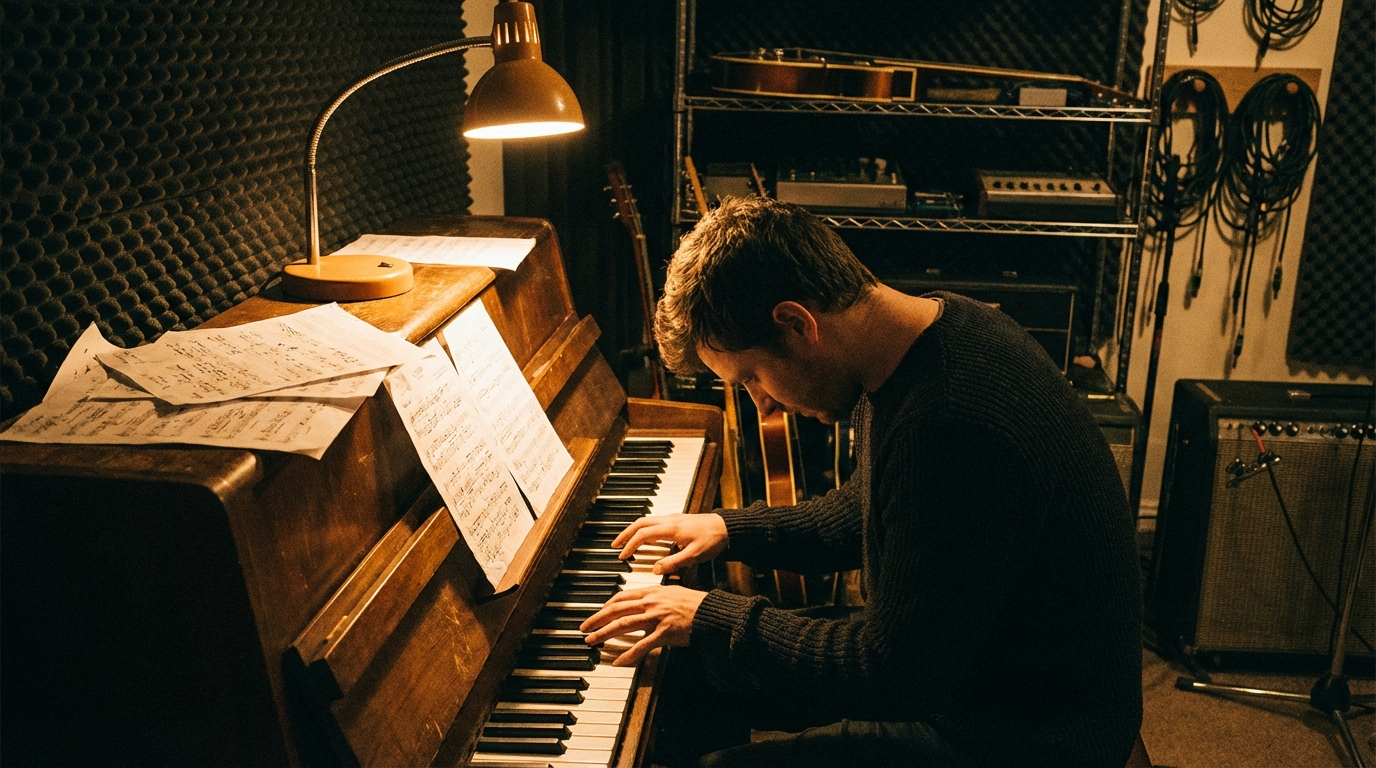
Here's a confession that might make traditional musical theatre writers cringe: I wrote my songs before I wrote the script.
I know that's not how it's "supposed" to work. The conventional dramaturgical wisdom for a true book musical (not a jukebox musical) is story first (scaffolding), then book, then identify the emotional peaks where songs belong, then compose to fit those moments.
It's sensible advice, but I ignored it completely!
The Method to My Madness
My process started with "song-spotting"—identifying the major emotional beats of the story and imagining what each song needed to accomplish. Before writing a word of dialogue, I had a detailed outline: 17 songs, each with a dramatic purpose, a rough emotional arc, and usually a title. I knew what was planned in between, and even had some key lines in my head, but barely a word of dialogue was written until I had the songs written.
I'm a lifelong consumer of musical theatre, an experienced amateur "triple threat" (admittedly weakest in the dance department, but still no slouch), and I would put forth the argument that I have a good natural sense of what makes for a good musical moment after watching, listening, and performing in countless shows. There's an easy trap writers can fall into - making songs without a purpose (e.g. I'm happy, so I will sing a song about happiness, or "here is a song about the scenery in this place"). Instead, the songs are the peaks, and the dialogue is the paths up the mountains the characters must climb to get there.
Best advice I ever heard in this area - in musical theatre, your characters must sing when the moment is too big for words.
So for me it made more sense to start with those moments. I wanted to create the "mountain range" first and then write the paths later.
What Worked
The biggest advantage of this approach: the songs drive the story. Because I knew exactly where each number landed and what it needed to accomplish, the book became a delivery system for musical moments rather than a novel with songs awkwardly inserted.
It also created more thematic cohesion. Musical motifs weave through the entire score because I could see the whole picture while composing. A melody that appears in the opening number returns, transformed, in the climax. Characters - and setting s- have sonic signatures that evolve with them. The score isn't a collection of songs—it's a continuous musical presentation that tells a story in its own way.
What Was Challenging
The obvious risk: what if a song doesn't fit the scene once you write it? This happened multiple times (and it's likely to happen again). I had to either rework the song or adjust the book to make the moment land. It's humbling to realize your beautiful bridge doesn't actually connect the shores you thought it did, and I have thrown away some great songs.
I had to throw away a GREAT song... my first take on the finale. Regrettably, it just didn't fit any longer when the story outgrew it. I hope I can use it for something else in the future; it's a banger.
There's also the challenge of dialogue rhythm. When you write book scenes between pre-existing songs, you're fitting prose into musical negative space. Each scene has to build to a specific emotional launch point. It's like writing a speech that must end on an exact word, at an exact feeling, every single time. It was hard, but still, for me this made sense.
Would I Do It Again?
Absolutely. I'd recommend it, with caveats. But I can totally see why others would choose exactly the opposite path.
This approach works if you have a clear story structure before you start composing. I knew my myth, I knew my characters, I knew my emotional journey. The songs weren't written in a vacuum—they were written into a fairly detailed blueprint where I had built out the scaffolding and key beats that each scene had in store.
It also works if you're comfortable revising. Music-first doesn't mean "music-is-precious". I rewrote songs, cut songs, added songs. The score I have now isn't the score I started with. It's better, because it had to earn its place in the story. I have edited lots of lyrics and musical beats too. But my aim has been to nail those musical moments and let the story sing when it needs to.
The Takeaway
I'm not suggesting everyone should work this way. The "correct" process is whatever produces the best work. For me, it was letting the music lead while I had the ideas of the story in my head. This is a book musical - the dialogue needs the songs, and the songs need the dialogue. But you have to pick a lane!
The myth of Oisín and Niamh is, at its heart, a story about crossing between worlds. Writing this musical, I've crossed between the worlds of composer and bookwriter constantly. It's disorienting sometimes. But when the music and the words finally sync up—when a scene lands exactly on the downbeat it was always meant to hit, and when the moments line up and you can finally see multiple peaks—it feels pretty damn good, and I hope it will create great theatre. Thanks for reading.